Why Laptop Battery Health Percentage Keeps Dropping
Is your laptop's battery health dropping rapidly? Understand the reasons behind 'battery health drops laptop' issues and find practical solutions to stabilize your laptop's battery performance.
Noticing a sudden fall in your device’s charge report? Many users in the United States check a percent readout and worry it fell “too fast.” This guide separates normal age-related decline from fixable causes so you know when to act.
Modern lithium-ion cells show a steady, gradual decline with regular use. That rate is normal and expected. Short-term shifts often come from heat, heavy workloads, or a recent charge cycle recalculation.
One snapshot can mislead. Verify a trend by checking Windows reports, comparing design capacity and full charge capacity, and using BIOS or maker tools for confirmation.
We’ll walk through: confirm the drop in Windows, interpret capacity numbers, cross-check in BIOS or manufacturer apps, then adjust charging habits and system settings.
Outcome: you’ll learn to manage routine wear, reduce damage from high heat or heavy load, and know when to plan a replacement.
Key Takeaways
- Expect gradual decline with everyday use; rapid shifts need investigation.
- Confirm trends over days, not a single reading.
- Compare design vs full charge capacity to gauge true wear.
- Use BIOS and manufacturer tools to verify Windows readings.
- Adjust charging habits and settings to slow further decline.
- Plan replacement only after confirming persistent, significant loss.
What “Battery Health” Percentage Means on Modern Laptop Batteries
Over months and years, a portable device’s stored energy capacity slowly falls as its chemistry ages. The percent you see is a simple ratio that compares present storage to the original design.
How the percentage is calculated: take the current full charge capacity and divide it by the design capacity, then multiply by 100. That result is the reported percent and shows long-term loss in usable capacity.
Design capacity vs full charge capacity
Design capacity is what the pack was built to hold. Full charge capacity is what it actually holds today. The gap between them grows with age and use.
Why ~80% matters
Users commonly notice runtime changes below about 80% because the device needs more frequent top-ups. This threshold is a practical sign to consider maintenance or planning a replacement.
How charge cycles add up
A full cycle equals 100% of charge used, but that can come from many partial drains. Typical design targets sit in the 300–500 cycles range, though good habits may extend usable life.
Understanding these terms makes Windows reports readable and turns a worrying percent into measurable facts. Learn more about our testing and care recommendations about our approach.
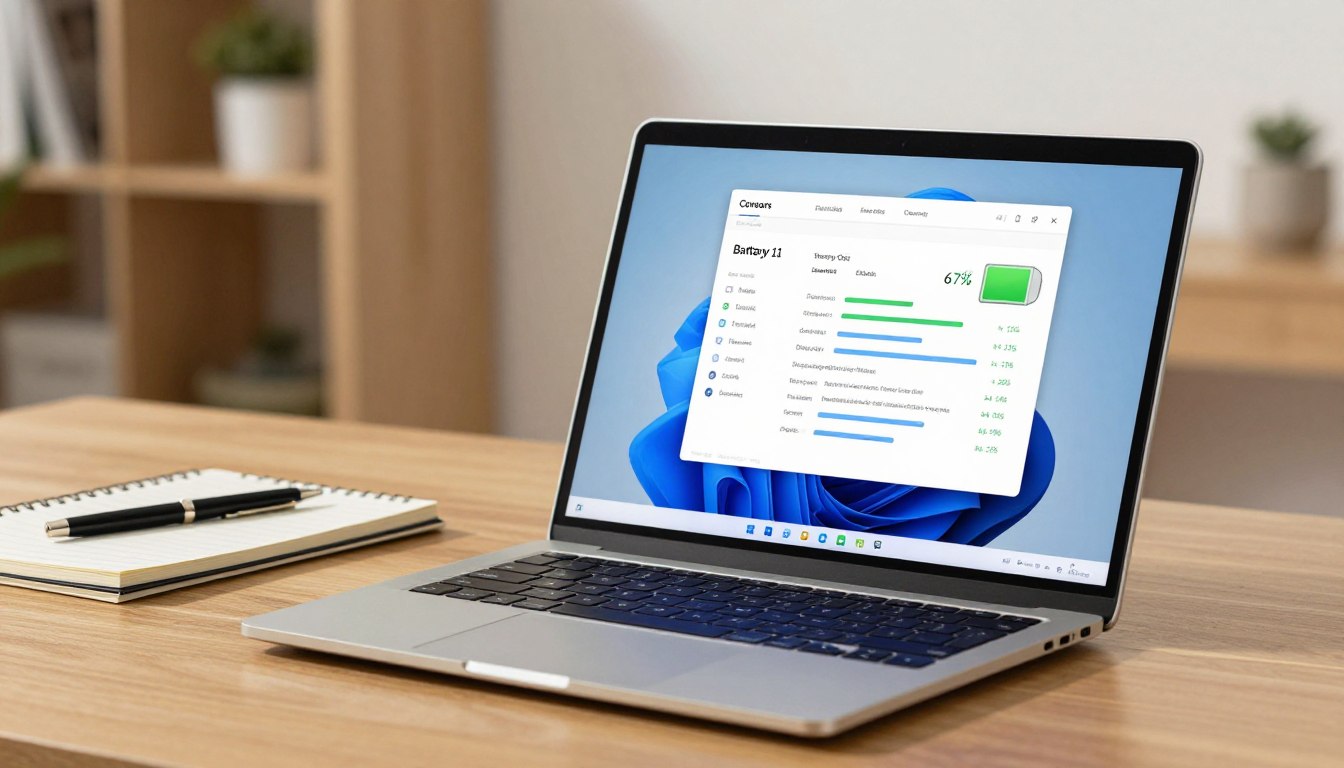
How to Confirm the Drop With a Windows Battery Report
An HTML report from Windows gives a date-by-date view of capacity and runtime estimates. Generate this file to check whether a drop is a trend or a single recalculation.
Windows 11: Open Windows Terminal (Admin), switch to PowerShell, paste powercfg /batteryreport /output "C:\battery-report.html", then press Enter.
Windows 10: Open Windows PowerShell (Admin) or Command Prompt, run the same command above, and note the system message that shows the saved file location.
Open File Explorer, go to the C: drive (or the path the message shows), and double-click the HTML file to view it in your default web browser.
| Report section | What to check | Why it matters |
|---|---|---|
| Installed battery | Design capacity, manufacturer data | Shows original specs to compare current values |
| Battery capacity history | Full charge capacity over dates | Confirms a real downward trend versus one-off change |
| Usage history / Battery usage | Daily load, run time, high-drain periods | Links usage patterns to faster decline |
Use the life estimates section to compare design-capacity runtime with current runtime. That helps explain why actual time on a charge may feel shorter even if capacity shows a modest change.
This report gives clear information to guide troubleshooting and decide if further checks in BIOS or maker tools are needed.

When battery health drops laptop: The Most Common Reasons It Happens
Several everyday habits and environmental conditions often explain why a percent readout falls faster than expected.
Heat and temperature exposure. Sustained temps above about 95°F accelerate chemical aging. Hot rooms, parked cars, direct sun, or blocked vents raise internal temps and speed decline.
Keeping the device plugged in at 100%. Holding a pack at full charge keeps voltage high. Over long periods that high-voltage state adds stress even with protection circuits in place.
Deep discharges and heavy tasks
Draining below ~20% regularly increases wear. Combine that with high-load work like gaming or video editing and the pack sees more cycles and higher internal heat.
Background apps, radios, and fast charging
Constant syncing, many browser tabs, and active Wi‑Fi/Bluetooth keep the system drawing power and warm, which raises wear over time.
Fast charging raises cell temperature faster than slow charge. Poor ventilation—using on soft surfaces or with dusty vents—prevents cooling and makes both charge and use more damaging.
| Cause | What to look for in reports | Quick fix |
|---|---|---|
| High temperature | Days with short runtimes, high full charge at same time | Move to cooler spot; clean vents |
| Constant full charge | Many AC-connected hours, little discharge | Use thresholds or remove charger at ~80% |
| Deep discharge | Repeated low-percentage events | Avoid 0–20% drains; recharge earlier |
| High-load use | Spikes in power draw on heavy-task days | Lower settings; use cooling pad for gaming |
Tip: Compare these patterns with your Windows report to confirm causes before planning repairs or replacement.
Cross-Check Battery Health With BIOS and Manufacturer Tools
A quick check in BIOS or your vendor’s app can confirm whether a reported loss is real. Windows gives useful estimates, but firmware and maker utilities provide direct system information.
BIOS/UEFI check: restart and press F2 repeatedly during boot. Open the Overview or General menu and find the battery status entry. Note the stated condition and any firmware warnings.
Manufacturer tools: These features add clearer labels and firmware-aware readings. They may show Excellent, Good, Fair, or Poor.
Dell-specific paths
In Dell Optimizer go to Power → About my battery. In Dell Power Manager open Battery Information. For a second opinion, restart and press F12 → Diagnostics.
| Source | Where to look | What it shows |
|---|---|---|
| Windows report | powercfg HTML | Capacity history and runtime |
| BIOS/UEFI | Overview / General menu | Firmware-level status |
| Dell tools | Optimizer / Power Manager / F12 | Clear labels and warnings |
If Windows shows a drop but BIOS and tools look normal, you may be seeing recalibration. If all sources agree, plan next steps to improve charging habits and reduce wear.
Charging Habits That Stabilize Battery Health and Slow Future Drops
How you top up and store a pack affects its long-term performance more than most people expect. Small, consistent habits cut stress on cells and keep usable run time steadier.
Use the 20–80 rule
Aim to keep charge between about 20% and 80%. That reduces high-voltage stress and avoids deep-discharge cycles. Over weeks this habit helps battery life and steady full charge readings.
Set thresholds when plugged in
Enable conservation or charging limits if your system offers them. Letting a pack sit at 100% for long periods raises wear. Thresholds keep the cell in a gentler range while you work on AC power.
Prefer slower charging and cool storage
When possible, use slower charge modes to reduce heat. Avoid charging in hot rooms; keep temperature under ~95°F and avoid soft surfaces that trap heat.
| Habit | Why it helps | Quick action |
|---|---|---|
| 20–80 rule | Reduces voltage stress | Top up before 20%, unplug near 80% |
| Charging thresholds | Prevents constant full charge | Enable vendor conservation mode |
| Slower charging | Lower charging heat | Use standard adapter or delay fast mode |
| Storage at 40–60% | Minimizes long-term stress | Store in a cool, dry spot for weeks |
Note: These practices will not restore lost capacity but will stabilize reported values and slow further decline. After several weeks you should see steadier capacity history and fewer abrupt changes in reports.
Windows Power, Performance, and Usage Tweaks That Reduce Battery Drain
Adjusting how your system handles power and background work makes the device run cooler and last longer between charges.
Use power modes and Battery Saver
Choose a more efficient power plan in Windows and enable Battery Saver to cut background activity and lower clock speeds. This reduces overall power draw and helps keep temperature down during normal use.
Lower display brightness and refresh rate
The screen is a major consumer of power. Drop brightness and, where supported, lower the refresh rate to reclaim meaningful runtime without changing core performance.
Manage startup items and background activity
Trim startup programs and restrict background apps in Settings. Closing unused apps and browser tabs reduces constant drain and fewer background tasks means fewer charge cycles.
Turn off unused features
Disable Bluetooth, keyboard backlight, and other radios when not needed. Turning off extra features stops steady, low-level draw that shortens daily runtime.
Keep software, drivers, and firmware updated
Updates often include improved power management. Install OS and driver updates to fix bugs that cause excessive draw and to improve reporting accuracy.
Improve ventilation for high-load sessions
Use hard surfaces, clean dust from vents and fans, and consider a cooling pad for sustained gaming or heavy tasks. Lower operating temperature multiplies the effect of other tweaks and slows wear.
| Area | Quick tweak | Why it helps |
|---|---|---|
| Power modes | Switch to Balanced or Power Saver | Limits CPU speed and reduces heat |
| Display | Lower brightness / reduce refresh rate | Less screen draw, longer runtime |
| Background apps | Disable startup items; limit background apps | Less constant drain and fewer cycles |
| Ventilation | Clean vents; use cooling pad | Keeps temperature down during heavy tasks |
After making changes, run another Windows report and compare usage history and life estimates to see if drain patterns improve.
Conclusion
Seeing a lower percent can be unsettling; the right data helps you decide what to do next.
First, confirm the trend with a Windows battery report. Compare design capacity and full charge capacity over time in the report to separate normal aging from an actionable problem.
Major causes to watch: high temperature exposure, leaving the device at 100% plugged in, deep discharges, and sustained high-load tasks that raise internal heat.
Best habit changes: follow the 20–80 approach where possible, enable charging thresholds or conservation modes, and keep the unit cool during heavy use and charging.
Action plan: measure now, adjust settings and routines, then re-run the battery report monthly or quarterly to confirm improvement or plan replacement.