What Causes Permanent Capacity Loss in Laptop Batteries
Discover the reasons behind battery capacity loss laptop and get step-by-step instructions on how to maintain your laptop's battery health in our comprehensive guide
Is your notebook no longer running like it used to? Many users notice shorter runtimes even after normal charging. This introduction explains why long-term chemical aging causes a steady drop in usable energy and what that means for day-to-day use.
Permanent capacity loss differs from brief runtime swings caused by apps or updates. It stems from internal degradation that reduces the pack’s effective charge over months and years.
This guide will pinpoint common root causes, show how to measure changes using Windows and OEM tools, and offer realistic prevention tips you can apply without changing how you work. Expect clear steps on interpreting reports, managing heat, and adjusting charging habits.
Why this matters: reduced runtime leads to more frequent charging and higher risk of unexpected shutdowns during travel or meetings. Modern, powerful systems and heavier workloads can speed up degradation compared with light office use.
Key Takeaways
- Permanent decline comes from chemical aging, not short-term swings.
- Measure with built-in reports and OEM utilities to track health.
- Heat control and charging habits make the biggest real-world difference.
- Expect realistic prevention steps rather than complete fixes.
- Monitoring performance helps avoid sudden shutdowns during critical work.
What “Permanent Capacity Loss” Means for Laptop Battery Health Today
To interpret long-term wear, learn the difference between an overall health grade and the measurable energy the cell stores now.
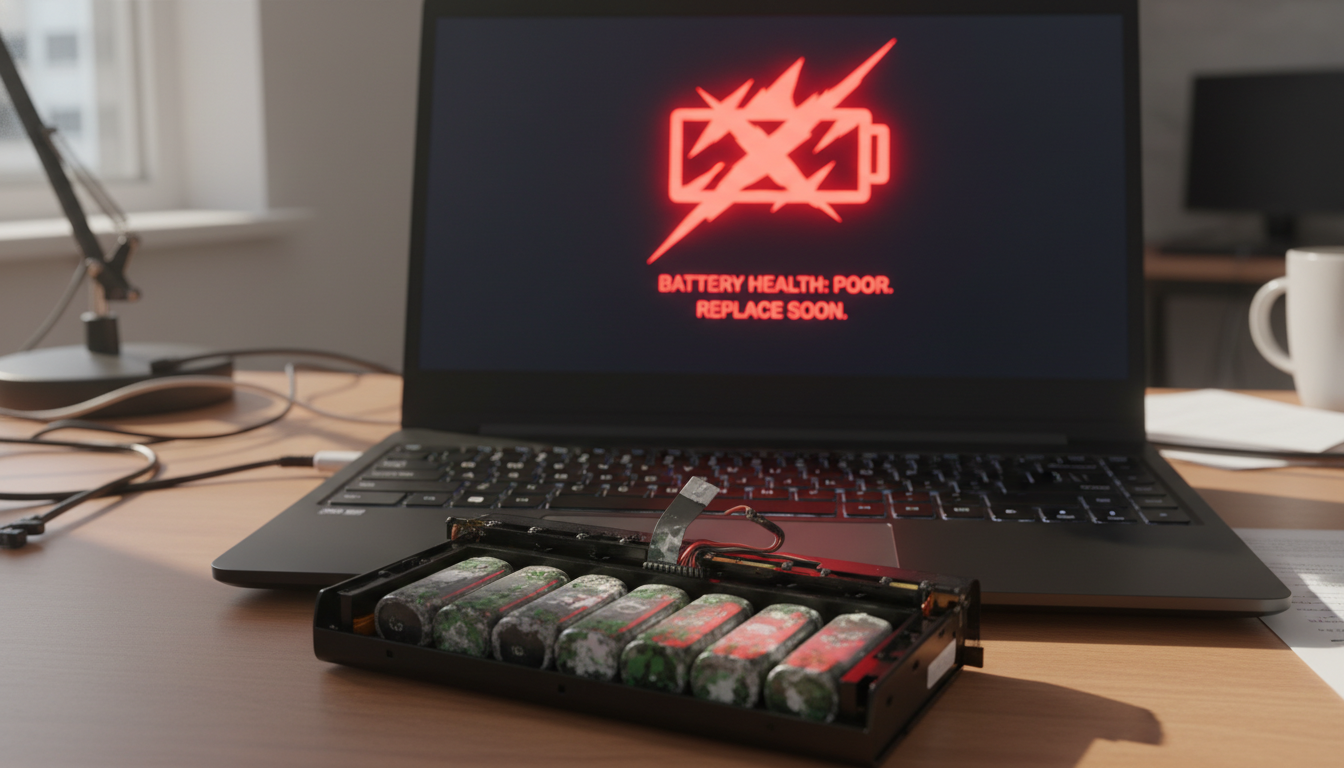
Battery health is a simple status shown as Excellent, Good, Fair, or Poor. It summarizes the pack’s condition at a glance. Battery capacity is the numeric amount of energy the pack can hold right now, usually reported in mWh or Wh.
Design capacity reflects what the cell could store when new. Full charge capacity shows what it holds today. The gap between those numbers is the practical indicator of permanent change.
Normal aging means a gradual decline over months and years, not a sudden drop overnight. Chemical wear inside lithium-based cells causes most permanent declines; once energy is lost chemically, recalibration rarely restores it.
- Temporary factors that can affect battery readings: recent heavy use, high temperature, or estimate errors.
- True battery degradation shows up as a steady gap between full charge and design capacity over time.
When the full charge value stays close to design capacity, health is strong. Wider gaps mean meaningful aging. Later sections will show how to track design capacity, full charge capacity, and cycle count to quantify this change.
How Long Laptop Batteries Typically Last in the Real World
How long a pack lasts depends on both calendar years and how many full charge cycles it sees. In practice, most modern lithium-ion batteries offer a usable lifespan of roughly 2–5 years or about 300–1,000 charge cycles. Many cells retain around 80% health after ~500 cycles, but results vary by model and use.
One cycle is one full equivalent discharge. Using 50% today and 50% tomorrow equals one full cycle. That practical view helps owners track wear without watching every top-up.
Runtime per charge depends heavily on usage patterns. Web browsing and word processing often yield 4–12 hours, while gaming, video editing, or 3D work can cut runtime by 50–75% even on a healthy pack.
Manufacturers’ “battery last” claims usually assume light, optimized conditions. A travel device that discharges daily will rack up cycles faster than a desk unit that stays mostly plugged in.
- Benchmark: 2–5 years or ~300–1,000 cycles is typical.
- Measure first: check current cycle count and stored energy before deciding on replacement.
Battery Capacity Loss Laptop: The Most Common Root Causes
Wear builds up over time when certain charging and usage patterns are repeated.

Charge cycles and deep discharges
Repeated full cycles and frequent deep drains speed chemical aging. Regularly falling below ~20% increases stress more than shallow top-ups.
Why it matters: deeper cycles create larger internal changes per cycle, so similar total energy moved can cause faster degradation.
Heat exposure and high operating temperatures
High temperatures accelerate harmful reactions inside cells. Gaming or heavy rendering while plugged in raises heat and compounds wear.
Ventilation and cooling directly affect how fast these reactions proceed over months and years.
Charging habits and usage patterns
Keeping a device at 100% for long periods, charging constantly under load, or using high-power profiles increases long-term stress.
Two identical packs can age very differently depending on these daily routines and airflow around the unit.
- Cumulative cycles, frequent deep discharges, and sustained heat are the main drivers.
- Short-term runtime drops differ from true, long-term capacity decline driven by repeated stress.
- Assess patterns before deciding on repair or replacement.
| Driver | Typical Effect | Easy Mitigation |
|---|---|---|
| Frequent deep discharges | Faster wear per cycle | Aim for partial charges; avoid 0% drains |
| High temperatures | Accelerated chemical aging | Improve cooling and avoid heavy loads while charging |
| Always at 100% while idle | Stress from high state of charge | Use charge limits or remove power when convenient |
Once you recognize these root causes, the next step is to confirm actual decline using Windows reporting tools.
How to Check Battery Capacity and Degradation in Windows Using Battery Report
You can generate a detailed health summary from Windows in under a minute using a simple command.
Run the report
Open PowerShell or Command Prompt as your user and run: powercfg /batteryreport.
To pick a location, add an output path, for example: powercfg /batteryreport /output “C:\battery-report.html”.
Find the file
The tool writes an HTML file. By default you’ll find battery-report.html in your user folder. If you set a path, check that location instead.
Key sections to review
- Installed battery — shows chemistry, design capacity, and the current full charge for a quick comparison.
- Recent usage and Battery usage — link daily drain and power draw to real-world runtime patterns.
- Cycle count — appears on some devices; use it as a sanity check for age versus wear.
- Battery life estimates — gives projected runtimes based on recent behavior; treat this as a guideline, not an exact value.
Why this matters: the report is the fastest way to quantify degradation without extra tools and it works on most Windows devices.
How to Interpret Your Battery Report Like a Pro
Learn to read the numbers so you can tell when wear affects daily run time and when a swap is justified.
Compare full charge to the original design value
Do a quick calculation: capacity loss % = (original design value − full charge) ÷ original design value.
This percent shows how much runtime you lost. A 15% drop is often noticeable in real use. You will charge more often and have less headroom for travel.
What cycles and cycle count tell you
One cycle equals 100% of charge used, even if spread across days. Partial drains add up fast, so daily top-ups can still create cycles.
Many consumer packs show notable wear near ~500 cycles, but heat and heavy use change that curve.
When to consider replacement
Use both numbers and use-case to decide. Office users may tolerate a 15% drop if runtime fits a desk routine. Mobile travelers and creators who need peak performance often choose replacement near 20% decline.
| Trigger | Why it matters | Action |
|---|---|---|
| <80% capacity | Runs shorter, travel risk rises | Plan replacement |
| Frequent unexpected shutdowns | System risk and data loss | Replace immediately |
| “Fair” or “Poor” health status | Objective warning plus inconvenience | Consider replacement |
Tip: ignore single-session runtime swings after heavy use. The numeric comparison between original design value and full charge is more reliable than time estimates alone.
Other Reliable Ways to Check Laptop Battery Health Beyond Windows
Accessing firmware screens and vendor utilities gives clearer, model-specific readings that complement OS reports.
Checking health in BIOS/UEFI
Reboot the device and press F2 to enter BIOS/UEFI on many systems.
Look for a Battery Health or Power section under Overview or General. Note the status label shown.
Using OEM tools (Dell examples)
Dell SupportAssist centralizes updates, diagnostics, and service alerts tied to your model. Run a quick check to get a guided health summary.
Dell Optimizer — open the app, go to Power, then select “About my battery” to record the health status for later comparison.
Dell Power Manager — open Battery Information to review Health and any conservation modes that affect long-term use.
On-board diagnostics and status indicators
Press F12 at boot to run Diagnostics. Choose Advanced Test → System Info → Health to view health labels and pass/fail results.
Common labels mean:
- Excellent — near original rating and normal runtime.
- Good — some reduction but fine for daily use.
- Fair — noticeable decline; plan replacement if mobility matters.
- Poor or Unknown — replacement typically recommended.
| Method | Where to access | What it shows | When to act |
|---|---|---|---|
| BIOS/UEFI | Reboot → F2 | Firmware health label, voltage or runtime hints | When label is Fair or below |
| Dell SupportAssist | Windows app | Guided diagnostics and update checks | Run monthly or before service |
| Dell Optimizer / Power Manager | Windows apps | Health, charging modes, conservation settings | Adjust settings to slow wear |
| On-board Diagnostics | Boot → F12 → Diagnostics | Detailed tests and health tab | On unexpected shutdowns or errors |
Tip: Record health labels from different tools and compare them over time. That gives a clearer picture than any single report.
Heat Management Steps That Prevent Permanent Battery Capacity Loss
Controlling operating temperatures protects chemistry and preserves usable energy over years.
Target ranges and why heat ages cells faster
Lithium-ion cells perform best near 68–77°F. Sustained temps above ~95°F speed internal chemical reactions and accelerate aging.
Hot conditions increase reaction rates, so the same number of cycles causes more wear at higher heat.
Common heat traps to watch for
High-performance gaming sessions, plugged-in heavy rendering, and high refresh rates generate steady heat.
Blocked vents on soft surfaces and putting a running device into a bag are other frequent traps.
Practical cooling tactics
Raise the rear for airflow and always run on a hard surface when doing heavy work.
Clean vents regularly and consider a cooling pad for long sessions. These steps reduce peak and sustained heat and help longevity.
Power and settings that help
When on battery, cap frame rates, use balanced power mode, and close unnecessary background apps to lower thermal stress.
Avoid charging while the device is hot; let it cool before plugging in to reduce compound stress.
| Risk | Why it matters | Quick fix |
|---|---|---|
| High sustained temperatures | Speeds chemical aging and reduces long-term usable energy | Use cooling pad, lower power profiles |
| Blocked vents / soft surfaces | Traps heat and raises internal temps | Place on hard surface, elevate rear |
| Charging while hot | Compounds stress from heat and charge current | Let device cool before charging |
Charging Habits That Extend Battery Life Without Micromanaging
A few simple rules for topping up will extend usable life without daily fuss.
Why partial charges beat 0%–100% cycles
Partial charges are gentler on lithium-ion chemistry. Moving between mid-range states reduces stress per cycle compared with repeated full discharges and full charges.
Aim to keep the charge between ~20% and ~80% when you can. This habit helps extend battery life by lowering the stress each session causes.
Stay out of very low charge levels
Running down to very low charge levels regularly increases wear. Deep discharges force stronger internal changes and raise the chance of unexpected shutdowns.
If you use the device every day, brief top-ups are fine. Avoid making deep drains a routine part of your usage.
When being plugged in helps — and when it hurts
Staying plugged in reduces cycle count and can be helpful for desk use. But sitting at 100% for long periods, especially under high heat, still creates stress.
Instead: enable OEM conservation or charge limit modes (many vendors offer an ~80% cap) while docked. Charge to 100% only before travel or long unplugged sessions, then return to partial charging habits.
Daily Power and Settings Tweaks to Reduce Drain and Slow Degradation
A few quick tweaks to power profiles and peripherals reduce draw and heat in minutes. These small changes lower daily wear and cut the number of full cycles you accumulate over time.
https://www.youtube.com/watch?v=FXd0d5U3PyQ
Use built-in power modes and background control
Switch to a balanced or power-saving profile when you need longer run time. Enable Battery Saver for short sessions to pause nonessential syncing.
Review startup apps and disable heavy background tasks. Identify high-impact programs and close them when not in use.
Adjust display and radios
Lower screen brightness; it often cuts draw the most. Turn off unused Wi‑Fi or Bluetooth and reduce keyboard lighting and refresh rate when possible.
Keep firmware and drivers current
BIOS, firmware, and driver updates can fix power-management bugs and improve charging behavior. Check OEM updates periodically for improved monitoring and efficiency.
Charger quality and storage tips
Use the correct wattage and an OEM or certified charger to avoid unstable charging or excess heat. If storing the device, leave it around 40–60% charge in a cool, dry place.
Using the device while charging
It’s fine to use your device while plugged in, but ensure good ventilation and avoid heavy loads on soft surfaces to reduce added heat.
Conclusion
Overall summary: internal chemical aging, amplified by heat, deep discharges, and stressful charging patterns, is the main driver of long-term degradation.
Measure first: compare original design and current full charge numbers, check cycle count, and match those figures against real-world runtime to see if reported changes match your experience.
If reported capacity decline is mild, focus on cooling and adjusting charging patterns. If degradation approaches ~20% with obvious runtime impact, plan a replacement and confirm the result with OEM tools, especially on Dell systems, to rule out reporting errors.
Keep temps low, avoid routine dips below ~20%, and favor partial charging. No battery lasts forever, but sensible habits stretch useful life and keep your laptop reliable longer.