Why Some Laptop Batteries Age Faster Than Others
Discover why your laptop's battery is aging fast. Learn the causes of battery aging fast laptop and how to prolong its lifespan effectively.
Why one device keeps runtime for years while another seems to lose it quickly is a common question for users in the United States. Lithium-ion chemistry slowly declines with use, so what many call sudden failure is often a steady loss of original capacity over time.
In daily use you feel this as shorter sessions for streaming, video calls, or hybrid work. Battery health is usually shown as a percent of original capacity, and many people notice meaningful runtime loss below about 80%.
Some packs last through hundreds of charge cycles, while others drop sooner. Key factors that speed this decline include heat, charging patterns, heavy hardware, and settings that keep components at high power draw.
Use this guide as a practical checklist: find likely causes, apply a few high-impact fixes, and verify change with built-in reporting tools over time. The goal is not no decline but a slower, predictable life so your device serves you longer.
Key Takeaways
- Li-ion packs degrade naturally; aim to slow the decline, not stop it.
- Watch heat, charging habits, and high-power settings to extend runtime.
- Check reported health percent; under ~80% you will notice shorter sessions.
- Make a few simple changes and track results with system tools.
- Common US uses like streaming and video calls increase power demand.
What “battery health” means and why batteries don’t last forever
Battery health is a simple percentage that compares how much charge a pack can hold now to its original design. A new device reads near 100%. Many users notice shorter runtime when that percent drops below about 80%.
Battery health as a percentage of original capacity
The percent reflects actual capacity, not the percent shown on the taskbar. Two devices can both show 50% charged yet one will run much longer if its health percent is higher.
Charge cycles and what counts as a full cycle
A full charge cycle equals 100% of use over time. Two 50% discharges add up to one cycle. Most packs are rated for roughly 300–1,000 cycles depending on quality and real-world usage.
- Lower capacity means fewer hours of run time even with normal operation.
- Cumulative cycles and heat-driven chemical changes reduce available charge.
- At ~90% you’ll see minor loss; near 80% runtime is noticeably shorter; below 80% consider planning a replacement for sustained life.
Normal battery aging vs sudden battery drain
A steady loss of runtime looks different from sudden, steep drops in charge — and they require different fixes.
Gradual decline reflects reduced capacity over months. That is expected with regular use and many charge cycles.
By contrast, sudden battery drain often stems from background activity, constant syncing, or a buggy software update. These issues can make the device run hot or show rapid percentage swings overnight.
Signs your drain is beyond normal wear
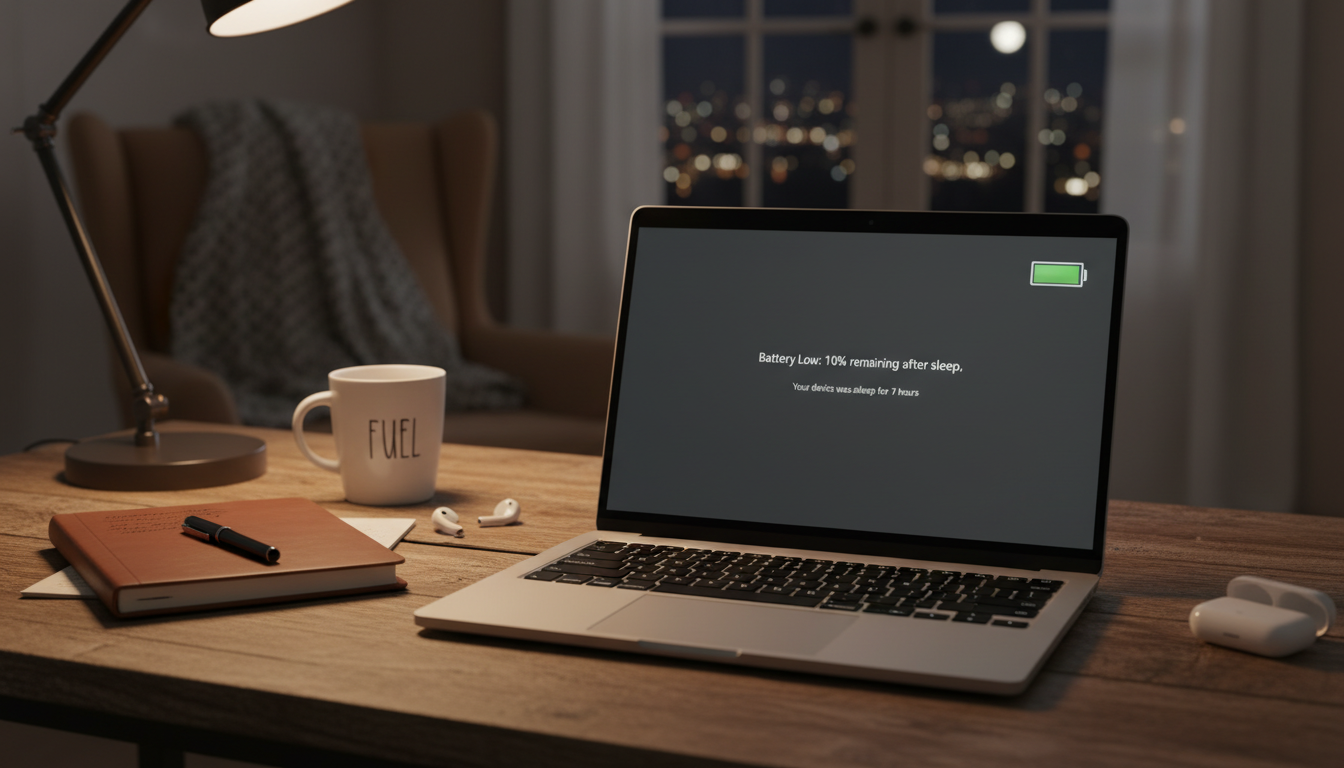
- Steep drops while idle or in sleep mode.
- Rapid percentage swings during light tasks.
- Hot case when you’re only browsing or typing.
- Unexpected shutdowns at moderate charge.
To separate an old pack from a hungry system, test in a controlled setup: same brightness, same apps, same network, and measure over several hours.
Start by diagnosing software and background processes first. These causes are reversible and often restore usable performance without hardware changes.
If problems persist after ruling out processes, drivers, and recent updates, then suspect a failing pack. Later sections explain how heat and charging habits affect both long-term decline and short-term drain.
Battery aging fast laptop causes tied to heat and temperature
Heat drives the reactions that wear down cells, so keeping temperatures low is one of the simplest ways to protect runtime.
Why heat is the primary enemy
High temperature speeds chemical reactions inside rechargeable cells. Those reactions create irreversible changes that reduce capacity and lower battery health over time.
Safe ranges and risk above 95°F
Operate devices roughly between 32°F and 95°F. The ideal band is about 68–77°F.
Sustained temperatures above ~95°F sharply increase long‑term capacity loss and shorten useful life.
Everyday heat traps and internal sources
- Leaving a device in a hot car or direct sun raises pack temperature quickly.
- Using it near heating vents or on soft surfaces blocks airflow.
- CPU/GPU load and charging both add internal heat even in warm rooms.
Ventilation mistakes that raise internal temps
Placing a device on a bed or couch can block intake and exhaust ports. Dust build‑up in vents and fans reduces airflow and lets heat accumulate.
Cold-weather effects
Temperatures below 32°F reduce available capacity and may prevent charging until the device warms. These effects are usually temporary and reverse after the device returns to normal range.
| Condition | Temperature | Effect on performance |
|---|---|---|
| Ideal | 68–77°F | Stable capacity, best long‑term health |
| Safe operational | 32–95°F | Normal performance, minor wear |
| High risk | >95°F | Accelerated capacity loss, permanent damage risk |
| Cold | Temporary reduced capacity and charging limits |
Charging habits that reduce battery capacity over time
Small changes in charging habits can add months or years to usable runtime. How and when you top up power changes stress on internal materials and affects long-term battery capacity.
The 20–80 guideline and why it lowers stress
Keeping the charge level between about 20% and 80% reduces electrode stress. This window limits high-voltage and deep-discharge stress that shave capacity over many cycles.
When to bend the rule: It is fine to charge to 100% for travel or long meetings. Occasional full charges have little effect compared with daily patterns.
Why staying at 100% while plugged in speeds wear
Holding a pack at 100% for long periods—especially while warm—raises chemical stress. Many manufacturers include conservation or battery limiter modes to cap full charge and protect battery health.
Deep discharges below 20% and their risk
Regularly dropping under 20% forces deeper cycling and increases stress per use. Over time this lowers usable capacity faster than moderate topping up.
Charging speed, heat, and when slower charging helps
High-rate charging can raise case temperature and stress cells. If you work at a desk, choose slower charging or overnight top-ups to reduce heat and extend life.
- Top up from ~40% to 80% during breaks.
- Plug in for heavy tasks to avoid deep discharge and high power draw.
- Use conservation modes when you keep a device plugged in for long periods.
Hardware differences that make some laptops have poorer battery life
Hardware choices set the starting point for how long a device will run unplugged. Not all models begin from the same baseline because pack size (watt‑hours) and internal components vary widely.
Small packs in thin-and-light designs
Thin-and-light designs trade internal volume for portability. That often means smaller capacity and less headroom for long unplugged sessions.
Power-hungry components that raise power consumption
High-performance CPUs, dedicated graphics, and high-refresh or ultra‑high‑resolution displays increase power consumption even during light work.
Performance tradeoffs and buyer guidance
Faster parts deliver better performance for gaming, editing, or 3D work, but they bring more heat and shorter battery life.
- Check specs: watt‑hours, CPU TDP, and whether graphics are integrated or dedicated.
- For long runtimes: prefer efficient processors and integrated graphics, and moderate display resolutions.
- Remember: poor battery life can be a design choice, not a fault — a healthy pack can still run out sooner on power-hungry systems.
Screen brightness and display settings that drain battery life
A bright display is one of the most consistent power draws. The screen can account for roughly 20–40% of total system power, and higher brightness or a high-resolution panel pushes that share upward.

Why the screen uses so much power
The backlight or OLED driver must light every pixel. Higher brightness and higher refresh rates increase power consumption quickly.
Higher-resolution panels also demand more GPU effort, which raises overall power and case temperature. More heat can speed internal wear over time.
How to reduce screen brightness without hurting usability
Adjust brightness in small steps and test readability. Turn on adaptive brightness if it works well in your environment.
Use night light or lower contrast at night to keep the display comfortable at lower brightness levels.
Which settings matter most
- Brightness level: primary lever to cut power.
- Refresh rate: lower it when you don’t need smooth motion.
- HDR: disable unless required; HDR raises power draw.
- Screen timeout: set a short blank-screen time for idle periods.
“Small brightness changes are among the fastest wins for longer runtime.”
Quick checklist: drop brightness 10–20%, enable adaptive control, lower refresh rate, and shorten timeout. Measure runtime in an hour to see the effect.
Background activity and applications running that cause battery draining
Hidden apps and services often sip power even while your device looks idle. That steady load can feel like sudden failure, when it is really software-driven work keeping the system awake.
Common culprits and why they matter
Cloud sync, collaboration clients, update services, telemetry, and vendor utilities often run in the background. They wake the CPU, use network I/O, and raise case temperature.
Review startup apps and background permissions (Windows)
Open Task Manager → Startup to disable unnecessary apps. In Settings → Privacy → Background apps, revoke permission for apps you rarely use. This reduces needless power use and improves day-to-day performance.
Browser tabs, multitasking, and resource spikes
Many open tabs or heavy web apps trigger CPU/GPU bursts. Close unused tabs, pause sync, and avoid running multiple heavy applications at once when on battery power.
| Culprit | How it uses power | Quick action |
|---|---|---|
| Cloud sync | Constant file checks and transfers | Pause or limit sync on battery |
| Collaboration tools | Background presence and notifications | Quit when idle or disable auto-start |
| Update services | Download and install tasks | Set active hours; update on AC power |
Measure impact with Task Manager and Windows power reports. Run a report before and after changes over the same time window to confirm reduced usage and lower power draw.
Power management settings that slow down battery aging
Small changes in system profiles and quick toggles can cut heat and idle draw, helping devices run cooler and last longer.
Choosing the right Windows profiles and Battery Saver
Pick Best power efficiency for long unplugged use, Balanced for mixed tasks, and Best performance when you need full speed. Turn on Battery Saver or set it to activate after a short idle time when you expect to be away from an outlet.
Processor power management to cut heat
Limit the maximum processor state on battery (for example to 80–90%). That reduces peak clocking, lowers case temperature, and helps protect battery health over time.
Wireless controls for Wi‑Fi and Bluetooth
Disable Bluetooth when unused, use Airplane mode in low‑connectivity situations, and enable Wi‑Fi power saving to avoid constant radio scans.
| Setting | Effect on power | When to use |
|---|---|---|
| Best power efficiency | Lowest draw, dimmer screen | Travel, long meetings |
| Balanced | Moderate performance and power | Daily mixed use |
| Best performance | Higher draw and heat | Gaming, heavy editing |
“A repeatable ‘on battery’ profile saves time and gives consistent, measurable savings in watts and heat.”
Software updates, drivers, and firmware that improve battery performance
When software and hardware fail to communicate efficiently, a device can waste power without you noticing. Regular updates often fix these gaps and reduce needless background activity.
https://www.youtube.com/watch?v=wb8QSh3pkXg
Why operating system updates can reduce drain
OS patches can eliminate background wakelocks, close buggy services, and improve scheduler efficiency. That lowers CPU wake-ups and cuts overall power use.
On windows, these fixes may target telemetry, driver handoffs, or sleep-state bugs that caused higher draw.
Firmware and driver updates worth checking
Keep chipset and graphics drivers current, and install OEM BIOS or firmware updates. These often refine charging algorithms, thermal limits, and reporting that affect runtime and performance.
Manufacturer utilities and practical steps
- Check: vendor battery management tools for charge thresholds (for example, 80% caps).
- Update: windows updates, chipset, GPU, and BIOS while the device is plugged in.
- Test: document baseline runtime and capacity report, then compare after updates under the same workload and time period.
“Updates won’t restore lost capacity, but they can stop avoidable drain and stabilize device performance.”
Best practice: update on AC power, avoid interruptions, and verify results with system reports. Small software and firmware changes often yield measurable gains in battery performance and device longevity.
Physical maintenance and daily handling to protect laptop battery life
A clean, well-ventilated device runs cooler and keeps usable capacity higher over time.
Dust and lint block airflow, raise internal temperatures, and speed wear. Regular upkeep reduces one of the main factors that shortens run time.
Cleaning vents and keeping airflow unobstructed
Inspect vents monthly. Use short bursts of compressed air from outside the case to dislodge dust. Avoid opening the chassis unless you have proper tools and guidance.
In dusty environments, increase cleaning to every 6–8 weeks to support stable cooling and extend usable life.
Best surfaces and accessories for cooling and stability
Use hard, flat surfaces like desks instead of soft sofas or beds. That keeps intake and exhaust clear.
Consider a stand or passive cooling pad when running heavy tasks. These accessories help lower case temperature and protect overall battery health.
Storage practices for weeks of non-use
For storage, leave the pack around 40–60% charge and place the device in a cool, dry spot below the high-temperature threshold. Check the charge level every few months and top to that range if it drifts.
Warning signs and next steps
Stop using the device immediately if you see swelling, unusual heat, a chemical smell, or a sudden drop in reported capacity.
Those signs often mean service or replacement is needed. Follow manufacturer guidance and seek qualified repair to avoid damage or safety risks.
“Regular physical care is a simple, low-cost way to protect run time and extend device life.”
Conclusion
Combine temperature control, the 20–80 charging habit, tuned power profiles, and fewer background applications for the best results. These steps together slow chemical decline and improve everyday battery life.
Start by measuring battery health and checking for abnormal drain from apps or services. If software or settings cause the issue, fix those first before assuming hardware failure.
Keep a simple maintenance cadence: clear vents, review startup items, and install firmware and software updates on a regular schedule. That keeps the system stable and cooler over time.
Replace the pack only if you see swelling, persistent overheating, or capacity so low it limits real-world use. Otherwise, small habits applied consistently will materially extend usable time.
strong, small changes done daily are the most reliable way to extend battery longevity and keep your laptop ready away from the charger.