Are Short Charging Sessions Bad for Laptop Batteries
Learn how short charging sessions laptop affects battery life. Discover best practices for charging your laptop battery in our latest guide.
Many people wonder if quick top-ups at a desk or between meetings harm their device. This guide defines those brief plug-ins and explains what really stresses a modern battery.
Modern laptops use lithium-ion cells with built-in management. They do not overcharge in the old sense. Heat, high state of charge, and deep drains cause most wear over time.
Think of wear as cumulative. Repeated cycles, sitting at 100%, and running hot add up. Quick plugs can be fine when the unit stays cool and the power draw is low.
This article answers whether many short plug-ins beat fewer long charges. It also shows practical steps: target mid-range charge where possible, avoid heat, and use OEM power tools to extend lifespan. You will learn how to check battery health on Windows, macOS, and Linux and when to unplug a warm device.
Key Takeaways
- Brief top-ups are not the main culprit; heat and extremes matter more.
- Avoid keeping a device hot while plugged in to protect the battery.
- Aim for a middle charge range when feasible to slow wear.
- Deep discharges below ~20% increase long-term degradation.
- Use manufacturer tools and updates to optimize battery lifespan.
What Short Charging Sessions Mean for Laptop Battery Life
Quick top-ups are when you plug in to add a small percent of energy instead of running the battery low and refilling to full. This practice matters because battery wear depends on total throughput and voltage exposure, not only on how often you plug in.
Why “topping off” differs from a full cycle
Topping off means adding 10–20% to the cell instead of discharging to near zero and refilling. A full charge-discharge cycle equals 100% of throughput over time. Multiple short fills only count as extra cycles when their cumulative use reaches that full 100%.
When quick plugs help — and when they hurt
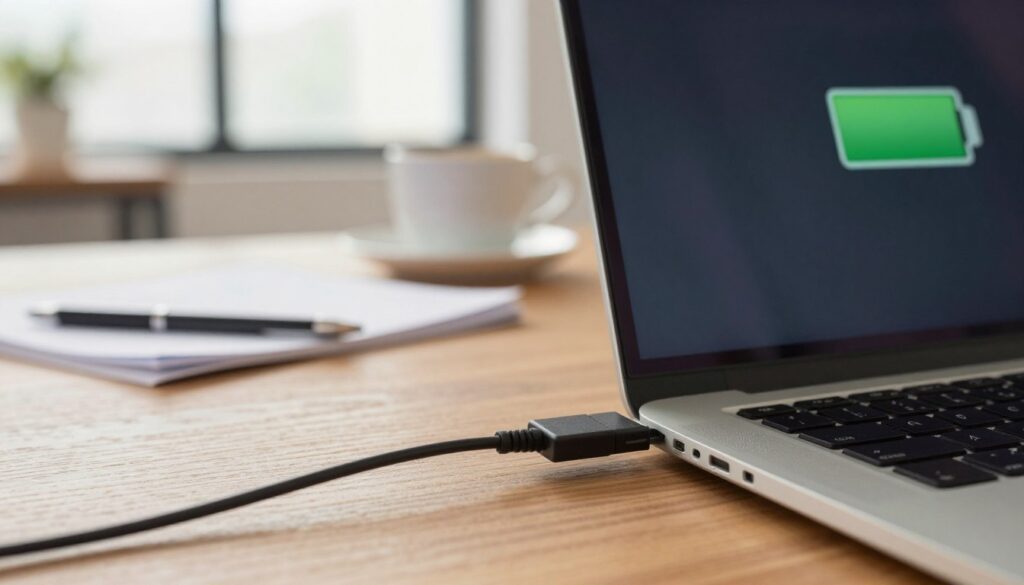
For example, using 50% today and 50% tomorrow then recharging equals one cycle, not two. In that instance, frequent top-ups do not automatically shorten battery life.
Short fills can protect the cell by avoiding deep drains below ~20%. However, repeated top-ups that keep a battery near 100% for long periods — especially while the device runs hot — increase stress and accelerate aging.
- Commuting or coffee-shop top-ups: useful if they keep charge in a moderate range.
- Constant full holds: risky when heat and high voltage coincide.
The best way depends on your use. Understanding cycles, chemistry, and temperature helps you decide how to use quick plugs wisely.
How Lithium-Ion Batteries Age: Cycles, Capacity Loss, and Lifespan
Battery cycle count measures total work done: one cycle equals 100% of charge-discharge throughput, combined across many partial uses.
Battery cycle count basics and the cumulative-cycle example
Charge cycles reflect cumulative use. Two 50% discharges that are recharged back to full add up to one full cycle.
This helps explain why frequent small top-ups do not always equal extra cycles on their own.
Typical cycle-count ranges and replacement timing
Most models list rated cycles between ~300 and 1000. For instance, some Apple models are around 500 cycles while some Lenovo units show ~300.
After several hundred cycles, you may notice reduced runtime even if the device still reports 100%.
What’s happening inside during the charge and discharge process
In lithium-ion batteries, ions move between electrodes during each charge and discharge. Repeated movement, high voltage, and heat alter electrode structure.
Electrode degradation and SEI buildup limit how much energy the cells can hold, so capacity declines over time.
- Practical takeaway: reduce heat, avoid deep drains, and limit prolonged 100% storage to slow wear and extend lifespan.
| Metric | Common Range | Real-world effect | Action |
|---|---|---|---|
| Rated cycles | 300–1000 | Predicts replacement time | Monitor cycle count |
| Capacity after hundreds of cycles | Noticeable decline | Shorter runtime | Avoid heat and full holds |
| Internal changes | SEI buildup, electrode wear | Reduced efficiency | Manage temperature and charge |
Best Practices for short charging sessions laptop Owners
Managing charge level and heat together gives the best protection for a portable battery over years of use. Follow simple practices to cut wear without changing how you work.
Keep charge between 20% and 80%
Aim for a daily range of about 20%–80%. This avoids deep-discharge stress and long periods at high voltage, which reduce capacity over time.
Avoid drops below 20%
Enable hibernation thresholds and use built-in Battery Saver on Windows or energy settings on macOS to prevent unexpected low-power events.
Handling 100% and leaving plugged in
The debate over holding a device at 100% centers on heat and trickle top-ups. If you need a full tank for travel, charge to full just before depart.
For desk use, it’s usually fine to leave plugged, but use a charge limit mode or unplug if the device runs hot or stays fully charged all day.
Temperature, storage, and tools
Protect temperature: keep vents clear, avoid hot cars, and let the unit cool if warm to the touch. Store unused devices near 50% in a cool, dry spot.
Use OEM smart charging modes and keep OS and driver software updated to improve power management and follow best practices for long-term health.
How to Monitor Battery Health and Charging Stress Over Time
Knowing where to find cycle and capacity data makes monitoring battery health fast and useful. Regular checks reveal trends so you can act before runtime drops or throttling begins.
Check cycle count on Windows, macOS, and Linux
On Windows, run powercfg /batteryreport in a command prompt and open the generated HTML to view charge cycles and capacity history.
On macOS, Option-click the Apple menu → System Information → Power to see cycle count and condition.
On Linux, tools such as upower or upower -i /org/freedesktop/UPower/devices/battery_BAT0 show design vs current capacity.
Use OS tools to lower background drain
Enable power plans, limit background apps, and set sleep/hibernation to reduce unnecessary power draw. Updated software and drivers help reduce repeat charges each day.
Watch for heat and aging signals
Track temperature during heavy use. If the device gets warm while charging or during calls, improve ventilation or lower the charge cap.
Faster-than-normal discharge, sudden shutdowns, or performance throttling are signs the laptop battery needs attention or replacement.
| Check | How | Why it matters |
|---|---|---|
| Cycle count | powercfg /batteryreport; System Information; upower | Shows cumulative wear |
| Capacity comparison | Design vs full charge capacity in report | Reveals real life runtime loss |
| Temperature | Use CoreTemp, Real Temp, or system monitors | High temp speeds degradation |
Conclusion
, Bottom line: keeping a moderate charge matters more than how often you add a little power. Short charging sessions can be fine because wear tracks cumulative cycles and stress, not plug-in count alone.
Stay mostly between ~20% and 80% to protect battery life. Watch temperature as your main cue: if the device feels warm while plugged in, cool it or enable a charge limit to cut stress.
It’s okay to top up to 100% when you need full runtime, even though long holds at full charge can speed wear. Use manufacturer smart modes and OS power settings so best practices run automatically.
Monitor cycle count and capacity now and then. That helps you plan replacement before reduced runtime becomes disruptive and keeps your device useful for years.